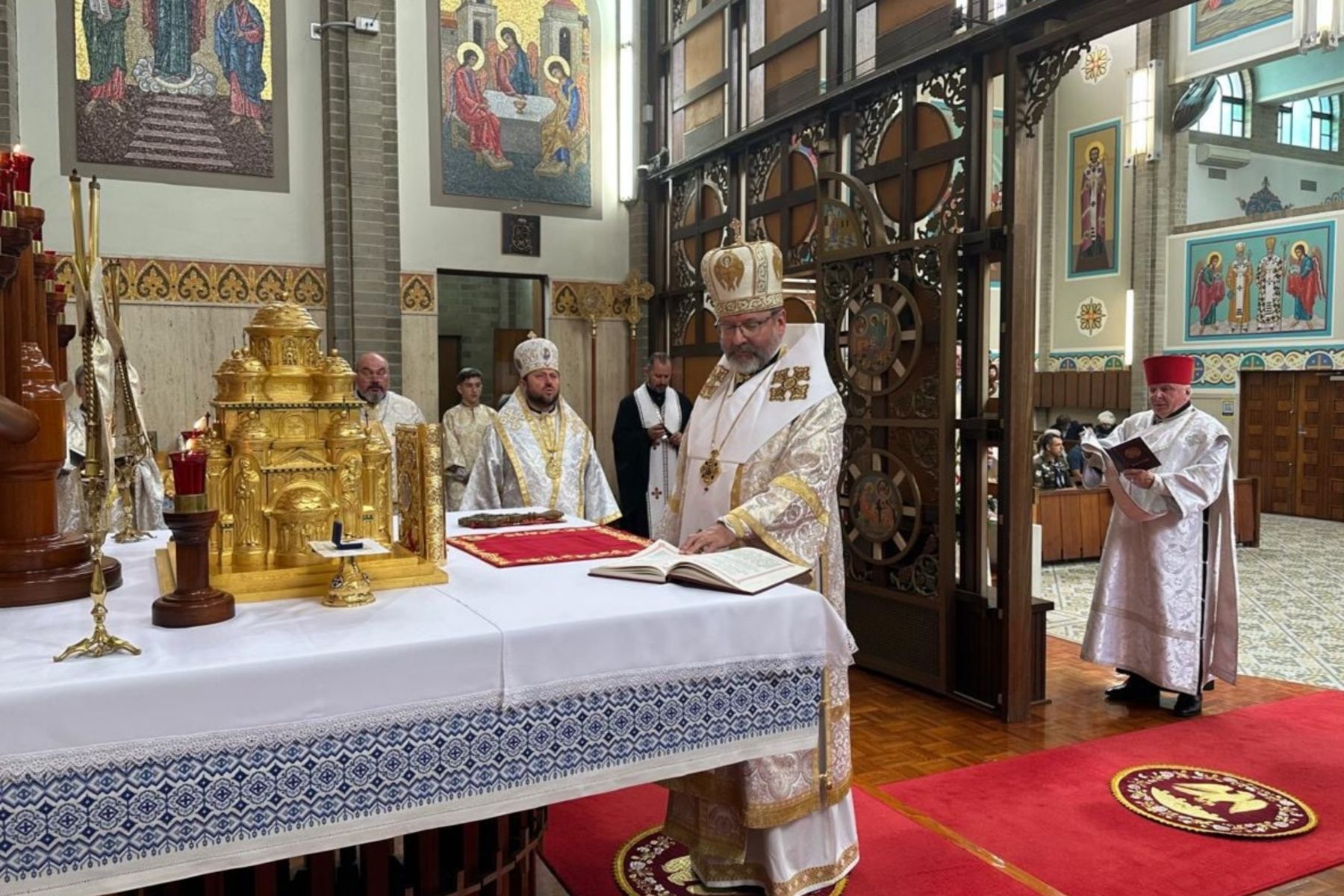
Homily of His Beatitude Sviatoslav on the Sunday of the Forefathers in Melbourne
December 15, 2025, 13:09
30
“When the fullness of time had come, God sent His Son…” (Gal 4:4)
Your Grace Bishop Mykola,
Reverend Fathers,
Dear brothers and sisters in Christ,
Reverend Fathers,
Dear brothers and sisters in Christ,
Glory be to Jesus Christ!
Today’s Sunday, within the rhythm of preparation for the Nativity of Christ, is called the Sunday of the Forefathers. On this day we honour the memory of all the righteous ones of the Old Testament who, in their spiritual searching, in full trust in God, and even through doubts and suffering, drew nearer the time of the Incarnation and the coming to us in human flesh of the Son of God. This very moment of the Christmas season, when the history of preparation and expectation was fulfilled, Sacred Scripture calls the fullness of time. The Apostle Paul speaks of it in this way:
“When the fullness of time had come, God sent His Son, born of a woman, born under the law, to redeem those who were under the law, so that we might receive adoption as children” (Gal 4:4–5).
Today, in the Holy Gospel, we hear about this prepared time in its fullness. The Lord tells His listeners the parable of those invited to a banquet. The fullness of time is presented there as a perfectly prepared feast. It is not closed or hidden from humanity—quite the opposite! The Lord prepared it precisely in order to fill each one of us, to make every person who believes in God and longs for His eternal Heavenly Kingdom a participant in this fullness of life and joy.
The banquet we hear about today is nothing other than the feast of eternal life and the Heavenly Kingdom, to which the Lord, like a gracious host, invites all who are called:
“A man once gave a great banquet and invited many. At the time of the banquet he sent his servant to say to those who had been invited, ‘Come, for everything is now ready’” (Lk 14:16–17).
To partake of the prepared feast means to share in the eternal life of the host himself. That is why one of the listeners exclaims:
“Blessed is the one who will eat bread in the Kingdom of God!” (Lk 14:15).
Yet those who are invited begin, one after another, to make excuses.
Let us pay attention to three very important points in this parable.
First, we are struck by the gentleness of the invitation. God imposes nothing on the human person; rather, He lovingly offers. In His love for us, He sends an invitation, and the only thing required of us is to respond positively—not to disregard or reject this opportunity. The Lord forces no one. All that He desires to give us is an invitation, like that of the host to the banquet. This open feast, offered to the whole human family, is participation in the eternal life of God the Father in His only-begotten Son, Jesus Christ, brought to fulfilment by the power and grace of the Holy Spirit.
The second important point of the parable is that God respects our choice. Each of us makes it by saying “yes” or “no” to His offer. At the same time, we must be attentive, because the Lord takes our free choice very seriously. He accepts our response with profound respect.
It is interesting to compare the three excuses given in response to the invitation with the three temptations by which the devil attacks Jesus Christ in the desert. The invited guests treat the call lightly. This is not merely a rejection of the food offered by the host—they reject the host himself. The three main reasons—possessions, power, and honour—become more important to them than life and the hospitality of the master. They believe they can manage without him. Everything he wishes to give them as a gift of hospitality, they think they can obtain on their own: through ownership of property, domination over others, and human recognition.
Therefore, let us remember: every time we reject God’s invitation addressed to us, the temptation of the devil is at work within us. How often do we invent excuses not to be present at the Divine Liturgy on Sundays and feast days! This is the attempt of the enemy of the human race to deprive us of the opportunity to become participants in the banquet of the fullness of eternal happiness, which is already open and accessible to us in Jesus Christ today.
The third point is that this invitation is unique and unrepeatable. There will not be another like it. The eternal life offered to us already here on earth is the source of our hope for the resurrection and life everlasting. The way we respond today will shape our life in eternity.
The invitation to the banquet and the place prepared at the feast of eternal life will never remain empty. When those originally invited refuse to come, the host once again sends his servant and commands him to call those he had not even considered at first. The Lord says:
“Go out quickly into the streets and lanes of the town, and bring in the poor, the crippled, the blind, and the lame.”
“Sir,” the servant said, “what you ordered has been done, and there is still room.”
Then the master said to the servant, “Go out to the roads and hedges and compel people to come in, so that my house may be filled. For I tell you, none of those who were invited will taste my banquet” (Lk 14:21–24).
Let us therefore take care that, through our own carelessness and negligence, we do not lose our place at the banquet of eternal life in the Kingdom of God.
Listening to this Word of God about the fullness of time that opens itself to each of us, and having received at this very moment a personal invitation to share in the joy of the Nativity of Christ, let us ask ourselves: how should we now prepare for this great feast?
Perhaps many of you will say: “We need to put up the Christmas tree or buy nice presents for our relatives and families.” A good and responsible father or an experienced homemaker might add: “We must prepare a proper Holy Supper with twelve dishes on Christmas Eve.” Yes—all of this is important, but it is not the most essential.
What, then, is the true and authentic preparation for Christmas? It is our participation in the Holy Mysteries, especially Confession and the Eucharist. For this banquet of the Heavenly Kingdom, open to us, is precisely the communion in the table of the Body and Blood of our Saviour. You are called to take part in it, having first prepared yourselves through the Sacrament of Confession.
Thus, the message of today’s Gospel is very clear: be ready—for everything is ready! Christ is coming to be born among us as a little Child. Do not neglect this invitation. Become participants in the joyful banquet of the Heavenly Kingdom, which we have just opened among you by the solemn proclamation:
“Blessed is the Kingdom of the Father, and of the Son, and of the Holy Spirit”—the invitation proclaimed at the beginning of this Divine Liturgy.
On this Sunday, our bishops of the Permanent Synod have travelled to various parishes—from Perth to Sydney and Brisbane—to invite all the faithful of our Church in Australia to the banquet of the Heavenly Kingdom.
Today here in Melbourne, together with Bishop Mykola, we are concluding our ten-day period of ministry among you—the first Permanent Synod of Bishops of our Church ever held in Australia. Allow me, first of all, to thank you for the hospitality with which you welcomed us. I sincerely thank you for every smile, every handshake, the many shared photographs, and personal encounters. I also thank you for not neglecting our invitation to come—not only to the banquet we shared last Sunday, but to something far more important—the banquet of the Heavenly Kingdom, the Divine Liturgy.
Thank you for your participation in the Eucharist during these historic moments in the life of our Church. As we conclude our visit, allow me to express, on behalf of the entire Church, our gratitude for your solidarity, prayers, and remembrance of our suffering in Ukraine.
As we return home, we will be witnesses to our living Church in Australia. I promise you that I will convey to the people in Ukraine the message of all the good we have seen here—of the assurances of support we have felt, both from representatives of government and local authorities, and from each one of you.
I wish you a blessed and fruitful time of preparation for the Nativity of Christ. I wish you a joyful Christmas and a blessed, happy, and victorious New Year—for Ukraine and for each of us, Ukrainians throughout the world, as the New Year now approaches.
May the Lord bless you!
Glory be to Jesus Christ!
† SVIATOSLAV
Other homiletics
More